📋 Market Research Report | Software & AI Sector | SKU: PMR-121676
Global AI in K-12 Education Market Size & Forecast to 2032
Industry Analysis, Market Share, Key Players, Growth Drivers & Forecast to 2032
A comprehensive, data-driven analysis of the AI in K-12 education landscape covering intelligent tutoring systems, personalized learning platforms, NLP and ML tools, regulatory dynamics, regional demand patterns, and competitive intelligence across the United States, Europe, and Asia-Pacific.
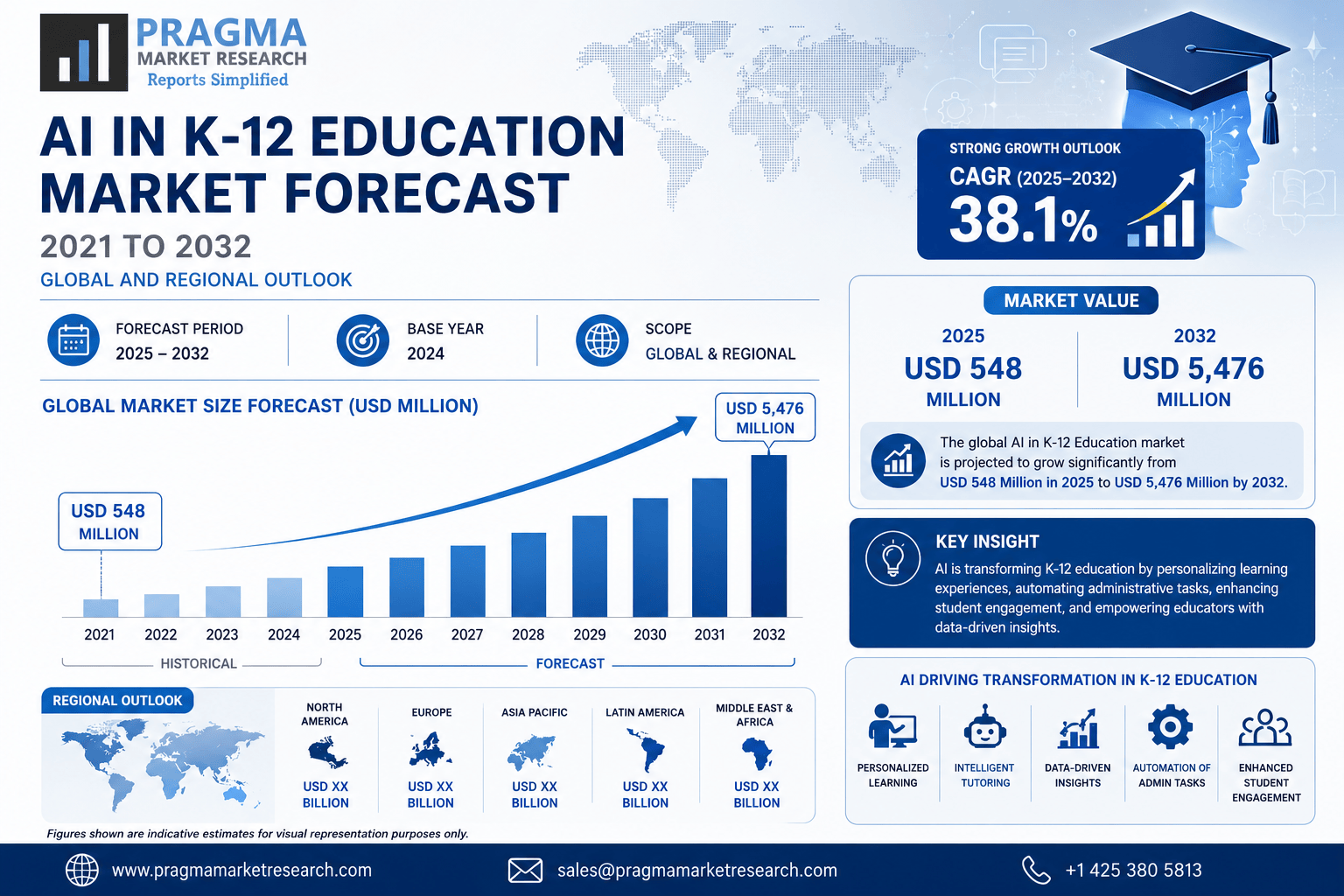
Figure 1: Global AI in K-12 Education Market Revenue (USD Million), 2021–2032. Source: Pragma Market Research (PMR-121676). Last Updated: June 23, 2026.
The Global AI in K-12 Education Market was valued at USD 548 million in 2025 and is projected to grow at a remarkable compound annual growth rate of 39.5% from 2026 to 2032, reaching USD 5,476 million by 2032. This surge is driven by the convergence of post-pandemic digital learning infrastructure, national digital equity mandates, and rapid advances in machine learning and natural language processing technologies that are fundamentally changing how students learn and how teachers teach in primary and secondary schools worldwide.
Key Insight: As the global K-12 education market accelerates its technology adoption, AI has moved from an experimental add-on to a foundational component of modern school infrastructure — reshaping student assessment, content delivery, classroom management, and teacher support across every major education system in the world.
Artificial intelligence in K-12 education encompasses the deployment of machine learning algorithms, natural language processing engines, computer vision tools, and predictive analytics systems within primary and secondary school environments. These technologies power a new generation of educational tools: intelligent tutoring platforms that adapt in real time to each student's learning pace, automated grading engines that provide instant feedback at scale, virtual teaching assistants that answer student queries around the clock, and classroom management systems that flag early signs of disengagement or learning difficulty before they become persistent problems.
Data from the U.S. Department of Education and OECD Education at a Glance indicate that public investment in education technology infrastructure is now at an all-time high, with the US alone committing over USD 7 billion through the E-Rate program and COVID relief funds to upgrade classroom connectivity and digital learning tools. Each dollar invested in broadband and device access creates downstream demand for AI-powered educational software — creating a structurally supported demand channel that this report quantifies across geographies, product segments, and competitive positions.
What Is AI in K-12 Education?
AI in K-12 education refers to the application of artificial intelligence technologies — including machine learning, natural language processing, computer vision, and predictive analytics — in primary and secondary school settings to enhance teaching, learning, and school administration. Unlike standard educational software, AI-powered tools can adapt dynamically to individual student needs, monitor learning progress in real time, and support educators with data-driven insights that were previously impossible to generate at scale.
A complete AI-enabled K-12 learning ecosystem includes personalized learning platforms that recommend content based on individual performance, intelligent tutoring systems (ITS) that simulate one-on-one instruction, automated essay scoring engines, speech recognition tools for language learning and accessibility, early-warning systems that identify at-risk students, and administrative AI tools for attendance tracking, resource scheduling, and fraud detection. Compliance with FERPA in the United States and GDPR equivalents in Europe has become a non-negotiable requirement for any platform seeking district-level procurement approval.
Key Growth Drivers
Post-Pandemic Digital Infrastructure Investment
The COVID-19 pandemic permanently accelerated K-12 digital transformation. Schools that were forced to adopt remote and hybrid learning discovered the productivity advantages of AI-assisted platforms and have not reverted to pre-pandemic approaches. The US Elementary and Secondary School Emergency Relief (ESSER) funds — over USD 190 billion in total allocations — channeled significant resources into EdTech infrastructure, with AI learning platforms among the primary beneficiaries. This one-time infrastructure build is now generating recurring software and subscription revenue for AI vendors as schools renew and expand their deployments.
Personalization at Scale Is No Longer Optional
Traditional classroom instruction delivers the same content at the same pace to students with vastly different learning levels, speeds, and styles. AI-powered adaptive learning systems solve this at scale — adjusting difficulty, pacing, modality, and remediation in real time for each student without requiring additional teacher resource. Districts that have deployed adaptive platforms consistently report measurable improvements in standardized test outcomes, with some studies showing 15–20% performance gains among students using AI-assisted tutoring compared to control groups. These outcomes are driving procurement decisions at scale across North America, Europe, and East Asia.
Teacher Shortage Is Creating AI-Augmentation Demand
The United States alone faces a projected shortage of 300,000 teachers by 2030, according to the Learning Policy Institute. Similar shortfalls are emerging in the UK, Germany, and Japan. AI tutoring systems and virtual teaching assistants are increasingly positioned not as replacements for human educators but as force multipliers — handling routine instruction, grading, and student queries so that teachers can concentrate on higher-value mentoring, social-emotional support, and complex problem-solving activities. This structural labor dynamic is creating durable, policy-backed demand for AI in the K-12 classroom.
National AI-in-Education Policy Frameworks
Governments are explicitly incorporating AI literacy and AI-assisted teaching into national education strategies. The US National AI Initiative Act includes provisions for K-12 AI education programs. China's Ministry of Education mandated AI curriculum integration across all primary and secondary schools by 2025. The European Commission's Digital Education Action Plan 2021–2027 allocates EUR 2.1 billion toward digital education tools, with AI platforms qualifying as eligible investments. These top-down policy catalysts are translating directly into public procurement budgets that benefit vendors in this market.
Market Segmentation
The report provides granular revenue analysis across four primary dimensions, giving stakeholders a clear view of where demand is concentrating and where the strongest growth pockets lie through 2032.
By Deployment Type
Cloud-Based
On-Premises
By Application
Learning Platforms & Virtual Facilitators
Intelligent Tutoring System (ITS)
Smart Content
Fraud & Risk Management
Others
By Product Category
Natural Language Processing (NLP)
Machine Learning
By End User
Public Schools
Private Schools
Charter & Alternative Schools
International Schools
Intelligent Tutoring Systems: The Dominant Application
Intelligent Tutoring Systems represent the largest application segment in the AI in K-12 education market, valued for their ability to replicate the effectiveness of one-on-one instruction at a fraction of the cost. ITS platforms like those from Carnegie Learning and Pearson's Revel use reinforcement learning algorithms to identify knowledge gaps, select optimal problem sequences, and provide immediate corrective feedback — capabilities that correlate directly with improved learning outcomes in math, reading, and STEM subjects. Widespread adoption across US public school districts and UK academy chains is consolidating this segment's leadership position.
NLP: The Fastest-Growing Technology
Natural Language Processing is the fastest-growing technology category, driven by conversational AI tutors, automated essay and short-answer grading, speech-to-text accessibility tools, and multilingual content delivery systems. NLP tools are particularly impactful for English Language Learners (ELL), a population representing over 10% of US K-12 enrollment. As large language model (LLM) capabilities become embedded in consumer-grade educational apps, the barrier to deploying NLP at the classroom level is falling rapidly — accelerating the pace of adoption across all income segments.
Cloud Deployment: Dominant and Accelerating
Cloud-based deployment accounts for the majority of new AI in K-12 education deployments and is growing significantly faster than on-premises alternatives. SaaS subscription pricing eliminates large capital expenditure barriers, enabling individual schools and small districts to access enterprise-grade AI tools. The transition to cloud also enables seamless updates, real-time data synchronization across devices, and integration with existing LMS platforms like Google Classroom, Canvas, and Schoology — factors that have become baseline procurement requirements across North America and Europe.
Access the Complete 117-Page Research Report
Market sizing, company profiles, segment forecasts through 2032, and country-level data across 20+ markets available immediately.
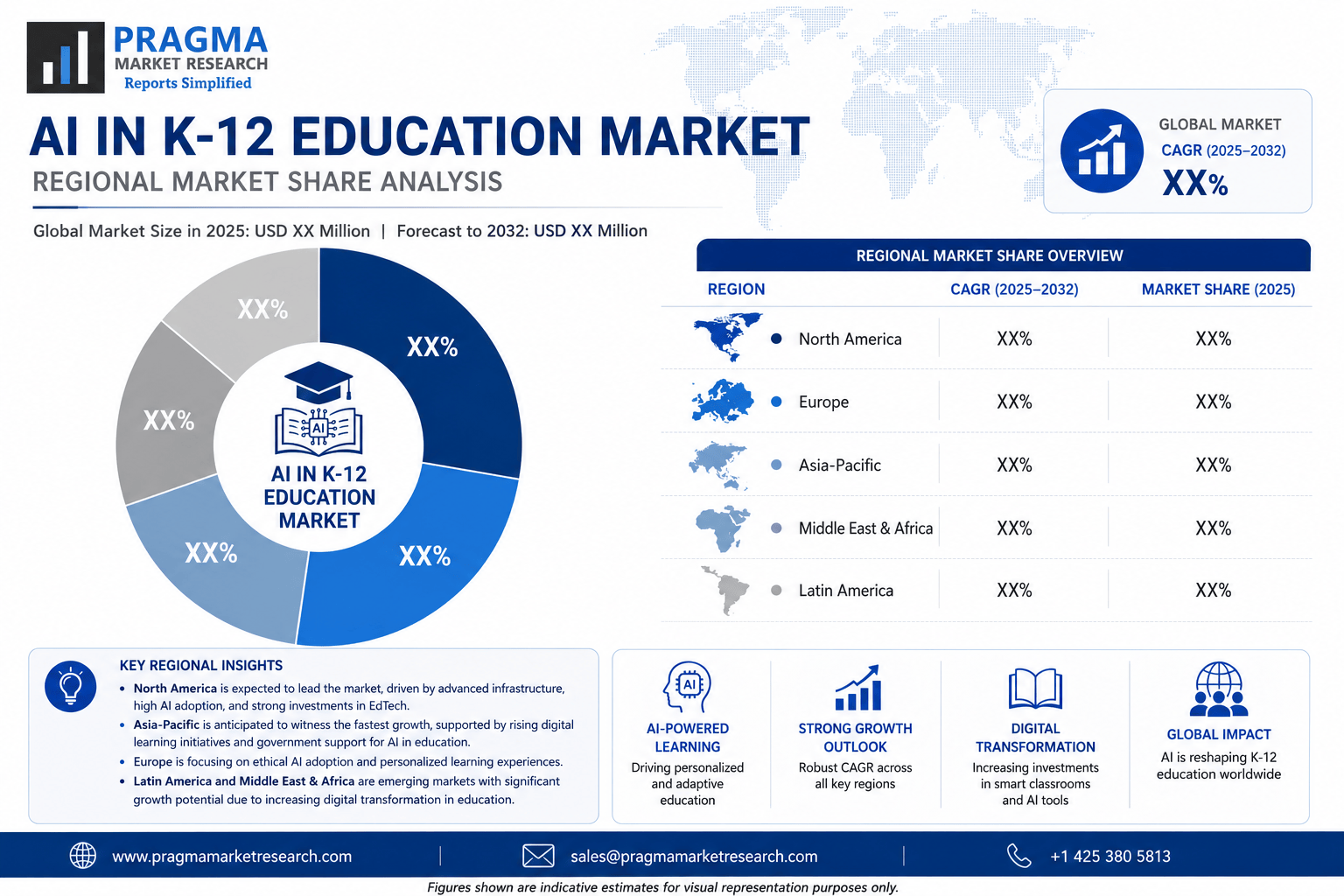
Figure 2: AI in K-12 Education Market Share by Region — 2025 vs. 2032 Comparison. Source: Pragma Market Research (PMR-121676)
United States & North America
North America holds the largest regional share, with the United States as the undisputed demand leader. Federal programs including ESSER relief funds, E-Rate connectivity subsidies, and the Every Student Succeeds Act's technology provisions have collectively funneled billions into K-12 EdTech infrastructure. Major school districts in New York, Los Angeles, Chicago, and Houston are deploying AI-powered tutoring and assessment platforms at scale, driving recurring subscription revenue for platform vendors. Canada's provincial education ministries are following suit, particularly in Ontario and British Columbia.
Europe
Europe is the second-largest region, with the UK, Germany, France, and the Netherlands as the most active markets. The UK's Education Endowment Foundation has funded multiple AI tutoring trials with measurable outcome data, creating an evidence base that is accelerating procurement confidence. Germany's national digitalization pact for schools (DigitalPakt Schule) committed EUR 5 billion for school infrastructure, a significant portion of which is funding AI-capable hardware and software ecosystems. GDPR compliance requirements have become a competitive differentiator, with European-first data-processing vendors gaining procurement advantage in public school contracts.
Asia-Pacific
Asia-Pacific is the fastest-growing region and home to the world's largest K-12 student populations. China's Ministry of Education has mandated AI curriculum integration across all public schools, creating the world's largest single-country AI in K-12 deployment program. India's National Education Policy 2020 explicitly calls for AI-powered adaptive learning at scale, with EdTech unicorns including BYJU's and Vedantu pioneering consumer AI tutoring for primary and secondary students. Japan and South Korea lead in AI teacher-support tools, applying robotics and conversational AI in early childhood and primary education settings.
South America & MEA
South America is led by Brazil, where federal programs supporting digital education in underserved communities are driving EdTech adoption across public schools. The Middle East, particularly the UAE and Saudi Arabia, is investing heavily in AI-powered education as part of national human capital development strategies under Vision 2030 and UAE Centennial 2071 frameworks. Mobile-first AI tutoring platforms are particularly relevant in regions with high smartphone penetration but inconsistent PC access.
Key Companies & Competitive Landscape
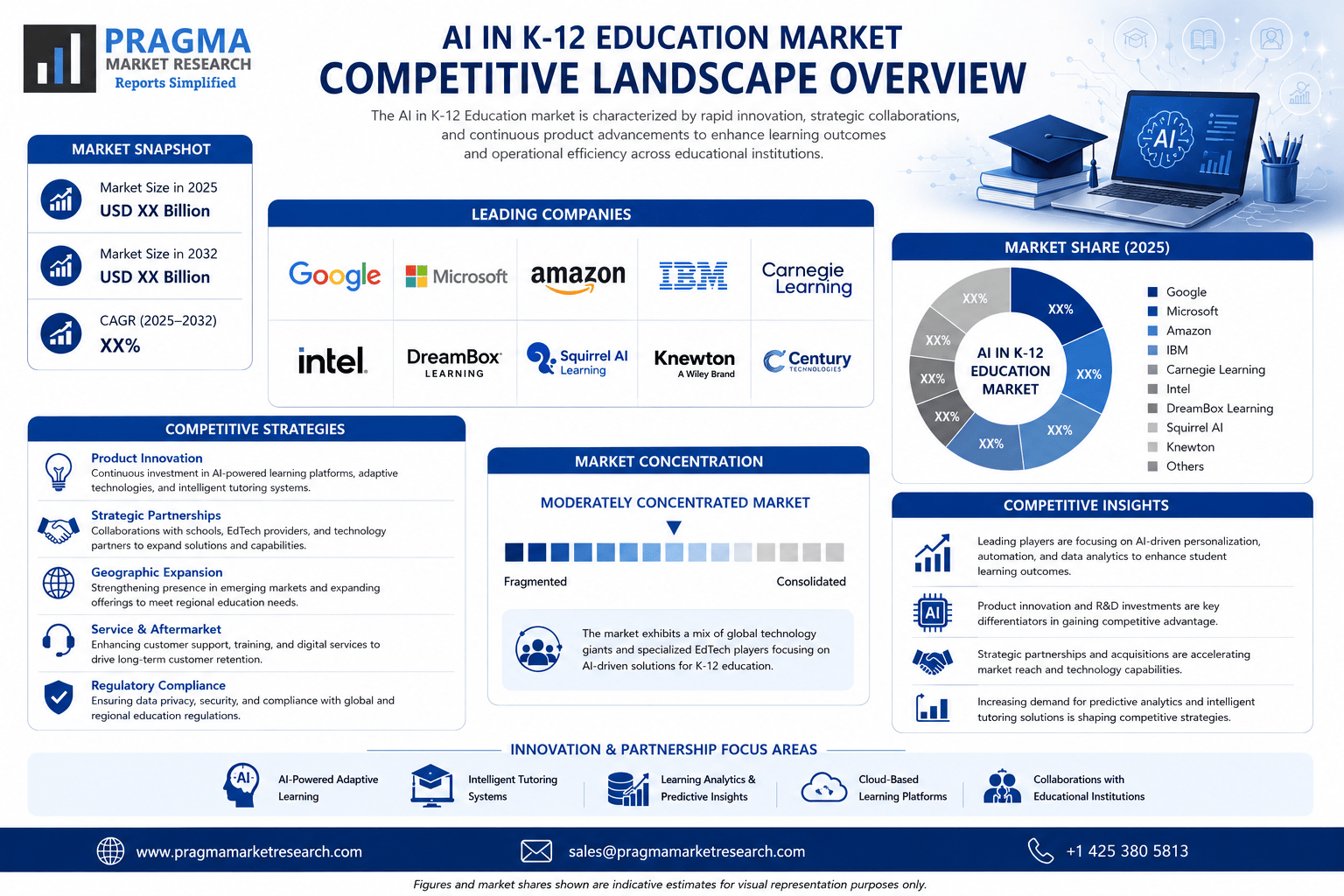
Figure 3: AI in K-12 Education Market — Competitive Landscape & Revenue Share Rankings (2025). Source: Pragma Market Research (PMR-121676)
The competitive landscape blends global technology platforms, established education publishers integrating AI into legacy content assets, and specialist EdTech vendors. Google LLC dominates classroom infrastructure through Google Workspace for Education and is aggressively integrating generative AI capabilities via Gemini across its Classroom and Meet platforms. Amazon Web Services provides the cloud backbone for hundreds of EdTech platforms while building its own AI tutoring tools through Amazon Future Engineer and AWS Educate programs.
Traditional publishers Pearson Plc, McGraw Hill, and Houghton Mifflin Harcourt are transforming their content businesses by embedding adaptive AI engines into digital textbooks and assessment platforms — leveraging their existing district relationships and curriculum alignment to defend share against pure-play EdTech entrants. IBM brings enterprise AI capabilities via Watson to school administration, learning analytics, and early-warning systems. The full competitive analysis including company financials, product portfolios, recent strategic moves, and positioning maps is covered in detail in the complete market research report — view details and purchase directly here.
Technology Trends & Innovation
Generative AI Is Rewriting the EdTech Playbook
The emergence of large language models has triggered the most significant product transformation in K-12 EdTech since the introduction of the interactive whiteboard. Generative AI enables real-time Socratic dialogue between students and virtual tutors, automatic generation of differentiated lesson plans and assessment questions calibrated to curriculum standards, and instant translation of content into 100+ languages. Platforms built on GPT-4 and similar foundation models are reducing content production costs by 60–80%, enabling smaller EdTech vendors to challenge the content libraries of established publishers for the first time.
Multimodal AI Is Expanding Accessibility
The combination of speech recognition, computer vision, and natural language understanding is making AI education tools genuinely accessible to students with disabilities, language barriers, and non-traditional learning profiles. Real-time captioning and sign-language interpretation powered by computer vision, text-to-speech and speech-to-text tools that meet IEP requirements, and reading assistance engines that adapt to dyslexic students' specific decoding patterns are driving procurement across special education programs globally. Accessibility-first design has become a compliance requirement in US public school RFPs under IDEA and Section 508.
Learning Analytics and Early-Warning Systems
Predictive analytics platforms are giving school administrators and counselors an unprecedented ability to identify students at risk of dropout, grade retention, or mental health crises before these situations become acute. By analyzing attendance patterns, grade trajectories, behavior reports, and engagement data from digital learning platforms, AI systems can surface early-warning signals weeks or months ahead of crisis points. Districts including Fresno Unified and Dallas ISD have publicly reported reductions in dropout rates attributable in part to AI early-warning implementations — creating a growing body of outcome evidence that is accelerating procurement confidence among administrators.
Opportunities & Market Challenges
Where Vendors and Investors Should Be Looking
For vendors with curriculum-aligned content and compliant data practices, the AI in K-12 market offers exceptional growth visibility tied to non-discretionary public education budgets. The US market offers high-value district contract opportunities for vendors that can demonstrate FERPA compliance, IEP support, and measurable learning outcome improvement. The international market, particularly India, Southeast Asia, and the Middle East, offers volume growth through mobile-first, low-cost subscription models that can reach students in public schools not accessible to premium EdTech vendors.
There is also a significant underserved opportunity in teacher-support AI tools. While student-facing AI has attracted the majority of investment and media attention, educator productivity tools — AI lesson planners, differentiation assistants, progress report generators, and professional development recommenders — represent a large, recurring revenue opportunity with lower data-sensitivity concerns and faster sales cycles through teacher-direct channels.
For investors evaluating the broader EdTech market, AI in K-12 is attractive for its structural resilience: education budgets are countercyclical, student populations are stable and growing globally, and the displacement of traditional content and assessment spending by AI-first platforms creates a multi-decade secular growth story.
Challenges Worth Noting
The digital divide remains the most significant structural barrier. Students in low-income households and rural areas frequently lack reliable broadband and device access, limiting their ability to benefit from cloud-based AI tools regardless of platform quality. Teacher readiness and professional development is the second major constraint — even well-designed AI tools fail to deliver outcomes if educators lack the training to integrate them effectively into classroom practice. Data privacy concerns, particularly around biometric data and behavioral profiling of minors, are creating regulatory uncertainty that is slowing procurement decisions in several European markets.
Research Methodology & Author
Authored & Reviewed By
AD
Akshay Deshmukh
Senior Market Research Analyst – Software, AI & Education Technology, Pragma Market Research
Akshay specializes in AI and software market research across the education technology, enterprise software, and SaaS sectors, covering demand forecasting, competitive intelligence, and regulatory landscape analysis across North America, Europe, and Asia-Pacific. He has authored 40+ market intelligence reports across EdTech, HealthTech, and enterprise AI verticals.
Primary Research: In-depth interviews with K-12 district technology directors, school principals, EdTech platform vendors, education policy experts, institutional investors, and curriculum specialists across the US, Europe, and Asia-Pacific.
Secondary Research: Analysis of government education budget filings, school district RFP databases, EdTech company financial disclosures, academic research on AI learning outcomes, and national education strategy documents from 20+ countries.
Market Estimation: Combined top-down and bottom-up methodology triangulated across vendor subscription revenue data, school district procurement records, student population data, and technology penetration analysis by deployment type and region.
Validation: Preliminary findings validated by domain experts, cross-referenced against publicly available benchmark studies, and reviewed for methodological consistency before publication. Data updated June 23, 2026.
What is the current size of the AI in K-12 Education market?+
The global AI in K-12 Education Market was valued at approximately USD 548 million in 2025 and is projected to grow at a CAGR of 39.5% from 2026 to 2032, reaching USD 5,476 million by 2032. The report uses 2025 as the base year with forecasts covering five major regions and 20+ countries through 2032.
What is the expected CAGR for the AI in K-12 Education Market through 2032?+
The AI in K-12 Education Market is projected to grow at a CAGR of 39.5% from 2026 to 2032, making it one of the fastest-growing segments in the global education technology industry. This growth rate reflects accelerating adoption of personalized learning platforms, intelligent tutoring systems, and AI-powered classroom management tools across both developed and emerging education markets.
Which AI technology leads the K-12 Education Market — NLP or Machine Learning?+
Machine Learning currently holds the dominant technology share, primarily through adaptive learning algorithms and predictive analytics systems that power student performance modeling and early-warning platforms. Natural Language Processing (NLP) is the fastest-growing technology category, driven by conversational AI tutors, automated essay grading, multilingual content tools, and speech-based accessibility features — areas where generative AI advances are rapidly expanding capabilities and driving fresh procurement cycles.
Which regions drive the most demand for AI in K-12 education?+
North America, primarily the United States, holds the largest market share driven by ESSER infrastructure funding, federal E-Rate subsidies, and a mature EdTech procurement ecosystem. Asia-Pacific is the fastest-growing region, led by China's national AI-in-education mandates, India's NEP 2020 digital learning push, and strong adoption in South Korea and Japan. Europe follows, with the UK, Germany, and France as the most active markets under the EU Digital Education Action Plan.
Who are the leading companies in the AI in K-12 Education Market?+
The report profiles Amazon Web Services, IBM Corporation, Google LLC, Pearson Plc, Cognizant, Graham Holdings Company, McGraw Hill, Nuance Communications, and Houghton Mifflin Harcourt. Each profile covers company financials, product portfolios, recent strategic developments, partnership activity, and competitive positioning within the K-12 AI landscape.
What are the biggest challenges limiting AI adoption in K-12 schools?+
The primary challenges are the digital equity gap (unequal device and broadband access in low-income and rural areas), teacher readiness and professional development requirements, data privacy regulations governing student data (FERPA in the US, GDPR in Europe), and budget constraints at the district level especially as one-time pandemic relief funding expires. Vendors that offer affordable subscription pricing, built-in FERPA/GDPR compliance, and robust teacher training support are best positioned to overcome these barriers.
How do I access or purchase this research report?+
The 117-page report (SKU: PMR-121676) is available at pragmamarketresearch.com. Request a free sample, purchase directly, or contact the research team at sales@pragmamarketresearch.com or +1 425 380 5813 for custom research, regional deep-dives, or company-specific competitive intelligence.
► Make strategic decisions backed by quantitative market data and forward-looking revenue analysis.
► Understand regulatory dynamics across the US, Europe, and Asia-Pacific and their EdTech procurement implications.
► Identify which AI technology segments and geographies offer the strongest near-term growth potential.
► Assess competitive positioning against the nine most active players in the global K-12 AI landscape.
► Support capital allocation decisions with independent, third-party market intelligence updated to June 2026.
Client Reviews
4.8
★★★★★
42 verified client ratings | Out of 5
★★★★★
"Exactly what we needed for our EdTech investment thesis. The segmentation between ITS and personalized learning platforms was particularly well-structured and actionable."
Sarah L. ·
★★★★★
"The Asia-Pacific regional data was detailed in a way we hadn't found anywhere else. China and India coverage was especially strong. Very valuable for our market entry planning."
Marcus T. ·
★★★★☆
"Solid competitive intelligence on the major players. The company profiles gave us a clear picture of how the market is consolidating around a few large platform vendors."